

Sat Jun 27, 02026, 6:00PM UTC
Florencia Pierri
Insanely Curious: Preserving MIT’s Past to Inspire the Future
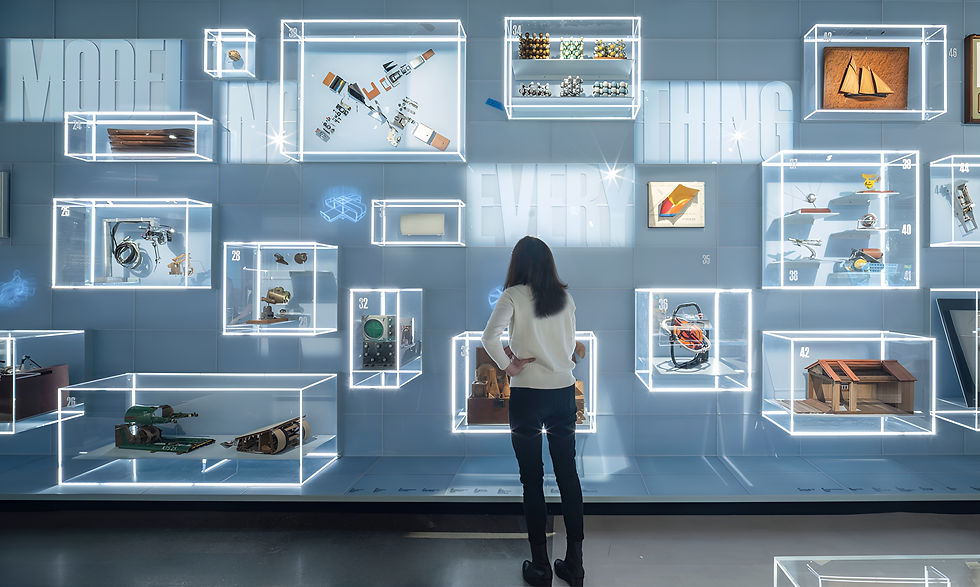
Why are things the way they are today? How did they come to be? How are they made?
How do you preserve something when you can't predict what the future will need?
Humans are collectors. We scoop up the shiny and the strange, the sentimental and the surreal — and somewhere along the way, Flori Pierri argues, those private hoards became museums: institutions that no longer simply own objects but hold them in public trust for a future they cannot see. In this talk, the MIT Museum's associate curator of science and technology makes a surprising case for a forward-looking audience — that the museum, an institution seemingly obsessed with the past, is in fact one of humanity's oldest and most durable exercises in long-term thinking.


Event Summary
Humans are collectors. We scoop up the shiny and the strange, the sentimental and the surreal — and somewhere along the way, Flori Pierri argues, those private hoards became museums: institutions that no longer simply own objects but hold them in public trust for a future they cannot see. In this talk, the MIT Museum's associate curator of science and technology makes a surprising case for a forward-looking audience — that the museum, an institution seemingly obsessed with the past, is in fact one of humanity's oldest and most durable exercises in long-term thinking.
The word curator comes from the Latin curare, to take care. To care for a permanent collection, Pierri notes, is to try to predict the future — to decide today which objects and stories will still matter to generations we'll never meet.
Pierri traces that practice across more than two millennia. It begins with the Museon of Alexandria (c. 290 BCE), a temple to the nine Muses and an institute for advanced study whose famous library was only one wing; it endured for some 900 years. Medieval Europe collected differently — the abbey of Saint-Denis guarded saints' relics, Charlemagne's sword (now in the Louvre), and a jeweled "unicorn horn" (in reality a narwhal tusk, now in the Rijksmuseum) — closed treasuries that advertised their owners' wealth and prized objects for their supposed magic. The Renaissance "cabinets of curiosities" shifted the logic again, valuing shells, specimens, and the ever-present armadillo for their own sake and, increasingly, for research. Francis Bacon gave that impulse a manifesto: collections should exist not to hoard wonders but to understand the world. The turn became institutional in 1683, when the Ashmolean opened at Oxford as the first purpose-built museum intended — radically — to be open to the public.
That lineage runs straight through MIT. Chartered in 1861 as "a society of arts, a museum of arts, and a school of industrial science," MIT placed a museum at the center of its founding vision — one in the Baconian mold, where objects are tools for teaching. Founder William Barton Rogers imagined a museum that would collect not the masterpieces of the past but the work of the present, capturing the cutting edge so the future could learn from it. The dedicated building was never funded, but the idea survived in MIT's departments. Architecture's William Robert Ware gathered exemplary drawings in Europe and, crucially, began systematically preserving student theses — a collection that now holds more than 8,000 drawings (1873–1968) and reads like a barometer of its eras (a moon base during the Space Race; roadside hotels as the interstate highways went in). The MIT Museum itself coalesced only later — historical collections in 1971, a permanent museum by 1979, the present name in 1980 — and today, at 314 Main Street in Cambridge, remains a committed collecting institution, charged with preserving everything significant to MIT's history.
What unites all of this, Pierri suggests, is a bet on a future that can't be predicted. They point to the Svalbard Global Seed Vault, built to last a thousand years and running a 100-year experiment on seed viability — not, in their reading, an act of doomsday despair but of optimism, an institution wagering it will still be quietly doing its work a millennium from now. And they surface the hardest version of the curator's dilemma through a recent MIT Museum display that pairs crystallographer Martin Buerger's 1931 X-ray apparatus — a full year of painstaking work to solve a single mineral's structure — with a present-day generative-AI model that does the same in seconds, for structures Buerger could never have cracked. How, Pierri asks, do you preserve something like an AI model for the future — and should you? The answer isn't settled, but the question is the point.
Museums, Pierri concludes, model what long-term thinking looks like in practice: commitments that outlast any individual, stewardship across deep time, things held in trust for a future that may value them differently than we do. The Museon lasted nearly a millennium; the Ashmolean has passed 330 years; the MIT Museum is only 50 — but the discipline is the same. We can't see the future clearly, but we can choose, now, to steward things carefully on its behalf.
In a wide-ranging Q&A led by Long Now Boston board member John Goodman, Pierri explored the tension between public display and preservation, the craft of telling stories with "hero objects" (and the pull of charismatic ones like Galileo's finger), the careful ethics of deaccessioning, museums reinventing themselves as "public laboratories," the stubborn magic of the authentic original versus the facsimile, and what they'd collect with unlimited means: the "points of conflict" of our divided age — proof, for some future visitor, that people endure.